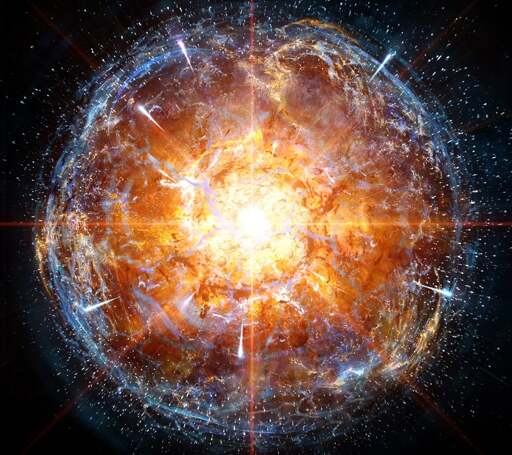
The big bang wasn’t a bang in the traditional sense—but it was nonetheless the start of important things: for one, space; another, time. Thirdly, it began the conditions and processes that eventually resulted in us humans, who can sit here and wonder about space and time. The big bang was, effectively, the beginning of the universe. According to the logic of human brains, it seems like there must have been something before the big bang, even if “before” is the wrong word because there was no time until after.
The good news for us is that physicists do have ways of thinking about—and even empirically studying—the origins of the origin of the universe. Counterintuitive and impossible as it may seem, cosmologists are even making progress in determining which wild ideas might peel back the veil on that early era, even though it remains inaccessible to telescopes.
Even after cosmology became a hard science, the field was a bit sketchy, Ismael says. “The science was one-and-a-half facts,” she adds. The sentiment, she says, is usually attributed to physicist James Jeans. But that has changed in the past century or so as the philosophers’ musings have wandered into the realm of theory, experiment and data. “These old conceptual questions are arising in ways that have new angles, a new spin and a new framework,” Ismael continues.
It’s unclear whether science as a discipline—and scientists as people—will ever be able to answer some questions definitively. After all, no one can “see” before the big bang, and no one will ever be able to—at least not directly. But the current and future universe, researchers are learning, may contain clues about the distant past.
You must log in or # to comment.
I like the idea that our universe was born from a supermassive star that collapsed in to a black hole, meaning that we’re in fact living inside that black hole. But that also implies that there’s not just one ‘universe’ in play, but in fact a whole nest of them, both larger than our own, and smaller. This video explores that idea:
https://www.youtube.com/watch?v=71eUes30gwc&t=16s
Note: I will never remotely become educated enough to come near to understanding the science, so it’s just a fun hypothesis for me… just about like all the others, in this case.