If he and his network were all using Proton/Tuta/etc. , would these emails have remained private?
I always presumed they got his passwords and simply logged into his accounts.
What’s the theory how the pwd was obtained?
Take a wild guess.
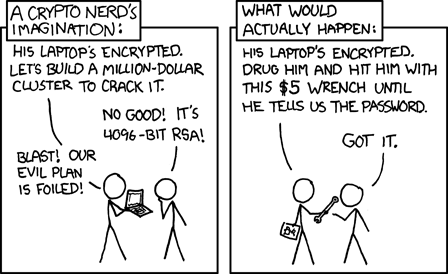
After seeing the state of some of the emails I wont be surprised to find the password was taped to the monitor. And was also “Guest”
Most people write it down someplace.
The catch with everything that implements E2EE is that, at the end of the day, the humans at each end of the message have to decrypt the message to read it. And that process can leave trails, with the most sophisticated being variations of Van Eck phreaking (spying on a CRT monitor by detecting EM waves), and the least sophisticated being someone that glances over the person’s shoulder and sees the messages on their phone.
In the middle would be cache files left on a phone or from a web browser, and these are the most damning because they will just be laying there, unknown, waiting to be discovered. Whereas the techniques above are active attacks, which require good timing to get even one message.
The other avenue is if anyone in the conversation has screenshots of the convo, or if they’re old-school and actually print out each conversation into paper. Especially if they’re an informant or want to catalog some blackmail for later use.
In short, opsec is hard to do 100% of the time. And it’s the 1% of slip-ups that can give away the game. As an example, we need only look to the group chat of cabinet members using a knock-off Signal client to discuss military operations, and accidentally added the editor of The Atlantic to the chat. Although that scenario highlights more PEBKAC than SIGINT.
What E2EE would do is prevent an internet or other service provider from viewing the data in transit. So without a warrant or other means, they’d have no ability do access these emails. Its also not how these emails were accessed, as far as we know.
This is the reason Jim Balsillie, the co-CEO of RIM (BlackBerry), was never sentenced for stock manipulation while he was running the company. All the incriminating evidence would be in his emails, which are encrypted on his BlackBerry and he has never agreed to decrypt them.
Many ways people implement that E2EE email service, is smoke and mirrors that still puts your data on to foreign servers – and if it touches/remains in a cloud space, even encrypted, I’d say there’s still the opportunity for the leak to occur (encryption algorithms require updates periodically for very good reason!). However, back around the time period this stuff was happening, I imagine that if they’d used a properly setup E2EE service that they controlled, the comms would not have leaked in this volume. Like it used to be common for even smaller/medium sized businesses to maintain their own Email and Blackberry messaging service servers in the 2005-2015 period, which kept comms internal to the company (barring hackers of course).
If they had that setup properly and with retention periods set for things like backups / old messages and so on, this sort of leak, I imagine, would not have happened.
IT Operations type roles in companies are less common these days, as most just dump things into the cloud (and options like BB went poof!), but there is a reason that such departments exist, and why some industries place a high premium on things like data retention (and getting rid of data when you legally can, to minimize this very sort of risk). Most of the people involved in these scandals, appear to be incredibly wealthy / business people etc – I mean, Bill Gates should’ve known for sure that this shit was highly leakable.
*Edit to add an obvious caveat, that if Epstein had been saving / retaining tons of information explicitly for future blackmail purposes or sale to foreign powers, then I mean… he was hoping to intentionally leak it, so if feds got access to wherever he was holding on to it, they’d likely get access. I’m also not totally sure where the sources for all of it came from, as I’ve not bothered to go through what all they collected – but I’d guess with the volume, it’s likely across various devices/accounts/media.
Remind me if a device was obtained and cracked to uncover any of these docs.
Bare in mind half of these emails are to a @gmail.com address, so they could have just asked google nicely
yeah, my point is that if it were Proton instead of Google, Proton wouldn’t have the option of providing the contents of the emails, because they would be encrypted. Correct me if I am wrong.
I haven’t heard exactly how the DOJ obtained the files/emails. It would be interesting to know that. I only see this from DOJ:
These files were collected from five primary sources including the Florida and New York cases against Epstein, the New York case against Maxwell, the New York cases investigating Epstein’s death, the Florida case investigating a former butler of Epstein, Multiple FBI investigations, and the Office of Inspector General investigation into Epstein’s death.
E2EE isn’t a magic defense against a court order.
I mean…if its properly implemented and the communicating parties don’t rat…it kinda can be.
Theres zero problem handing over the encrypted content. Its just not useful for a whole hell of a lot unscrambled