I propose the body temperature of an average opossum as the fixed point for 100 because they are cute as heck. We shall call this unit Possigrade. And anything above 100 Possigrade should be called the ‘rabies zone’ and 0 Possigrade should correspond to 8°C, as this feels very cold when dressed inappropriately. In addition, there is now the Bakers Possigrade, where 100 corresponds to 27°C, as this is the temperature at which sourdough bread rises by about ⅓ in 5.5 hours.
But seriously: Celsius is fine. On Earth, we are primarily interested in water at atmospheric pressure. Too many things contain water (pipes, food, paint, etc) and they react differently at 0 °C than at 4 °C. For this reason, we deliberately avoid using water in applications that are regularly exposed to sub-zero temperatures. Water is simply everywhere, so 0 °C and 100 °C are important tipping points for general use.
Celsius is great for engineering because Things Happen™️ when water starts boiling or freezing. But most people aren’t engineering daily. Cooking temps generally dont require much precision and there are too many niche break points to easily factor: safe meat temps, refrigeration temps, oil smoke points, Maillard reaction, etc… Our chefs are basically screwed no matter what.
That leaves measuring weather as the most universal daily application. Celsius is not great because the temp outside your door is going to be between mid -20º and mid 40º. It’s nice to have water freezing at 0º (snow, frost, ice) but thats the only interesting break point. You could just as easily set 100º to be the temperature of the sun and have the same daily experience.
Humans are endothermic, which means being somewhere hotter than us is Not Good™️. That would be very nice to set as a breaking point for weather purposes, but unfortunately the danger varies wildly with humidity/airflow/personal tempature regulation/hydration/etc… If we set the triple digit break to indicate an unsafe body temp then we at least can approximate the danger and get a little bonus medical utility.
Mean body temp varies slightly based on several factors:
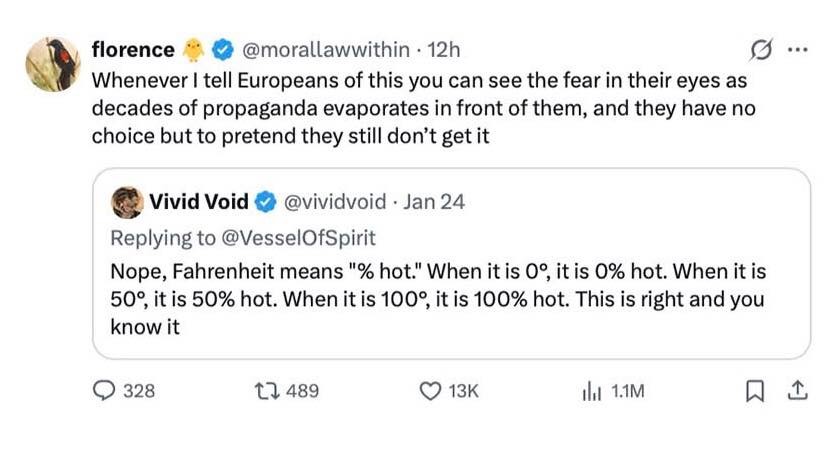
So set 100º to be one standard deviation over and its perfect for daily use. Checkmate Celciusts
Celsius is great for engineering because Things Happen™️ when water starts boiling or freezing. But most people aren’t engineering daily.
I’d argue that it’s more covenient to use a common scale for all applications of the same measurement than to have multiple different scales, just because that would eliminate all conversion concerns. Someone I know is in engineering school has switched entirely to using °C simply because that’s what they deal with at school anyway, to the point they don’t even write °C anymore in casual chats.
For other applications, it seems like the scales we’re used to are more or less arbitrary anyway, so that’s really just a matter of getting used to it. Some are used to calling ~70°F room temperature, others say ~20°C,
So if it matters for one case, but not so much for others, and we were to pick a single scale, I should think it would be ideal to go with the case where it does matter.
Or we just keep doing this thing where people use what they’re used to and we just quickly look it up or someone comments with the conversion and move on with our lives.
Humans are endothermic, which means being somewhere hotter than us is Not Good™️.
Endothermic refers to the ability of the organism to regulate it’s temperature, not just the ability to generate heat, but also to cool itself down. We humans are so good at it, that we can literally just jog prey down in hot environments and pretty much all animals will overheat before we do.
Hell, in my apartment there’s a room especially for making it very hot and humid. Even above 100c, and I still don’t boil. Weird, huh?
cooking temps generally don’t require much prevision
Perrsonally I set 100° Egg (or 100°E) to equal 180°F because that’s how much i want to heat my egg when i am making ice cream. Gets you a good, custardy base for your ice cream machine.
I would also accept °Icecreams or °Is as the units
zero would be 20°F because that is Ice Cream’s proper storage temperature.


I propose the body temperature of an average opossum as the fixed point for 100 because they are cute as heck. We shall call this unit Possigrade. And anything above 100 Possigrade should be called the ‘rabies zone’ and 0 Possigrade should correspond to 8°C, as this feels very cold when dressed inappropriately. In addition, there is now the Bakers Possigrade, where 100 corresponds to 27°C, as this is the temperature at which sourdough bread rises by about ⅓ in 5.5 hours.
But seriously: Celsius is fine. On Earth, we are primarily interested in water at atmospheric pressure. Too many things contain water (pipes, food, paint, etc) and they react differently at 0 °C than at 4 °C. For this reason, we deliberately avoid using water in applications that are regularly exposed to sub-zero temperatures. Water is simply everywhere, so 0 °C and 100 °C are important tipping points for general use.
Celsius is great for engineering because Things Happen™️ when water starts boiling or freezing. But most people aren’t engineering daily. Cooking temps generally dont require much precision and there are too many niche break points to easily factor: safe meat temps, refrigeration temps, oil smoke points, Maillard reaction, etc… Our chefs are basically screwed no matter what.
That leaves measuring weather as the most universal daily application. Celsius is not great because the temp outside your door is going to be between mid -20º and mid 40º. It’s nice to have water freezing at 0º (snow, frost, ice) but thats the only interesting break point. You could just as easily set 100º to be the temperature of the sun and have the same daily experience.
Humans are endothermic, which means being somewhere hotter than us is Not Good™️. That would be very nice to set as a breaking point for weather purposes, but unfortunately the danger varies wildly with humidity/airflow/personal tempature regulation/hydration/etc… If we set the triple digit break to indicate an unsafe body temp then we at least can approximate the danger and get a little bonus medical utility.
Mean body temp varies slightly based on several factors:
So set 100º to be one standard deviation over and its perfect for daily use. Checkmate Celciusts
I’d argue that it’s more covenient to use a common scale for all applications of the same measurement than to have multiple different scales, just because that would eliminate all conversion concerns. Someone I know is in engineering school has switched entirely to using °C simply because that’s what they deal with at school anyway, to the point they don’t even write °C anymore in casual chats.
For other applications, it seems like the scales we’re used to are more or less arbitrary anyway, so that’s really just a matter of getting used to it. Some are used to calling ~70°F room temperature, others say ~20°C,
So if it matters for one case, but not so much for others, and we were to pick a single scale, I should think it would be ideal to go with the case where it does matter.
Or we just keep doing this thing where people use what they’re used to and we just quickly look it up or someone comments with the conversion and move on with our lives.
Endothermic refers to the ability of the organism to regulate it’s temperature, not just the ability to generate heat, but also to cool itself down. We humans are so good at it, that we can literally just jog prey down in hot environments and pretty much all animals will overheat before we do.
Hell, in my apartment there’s a room especially for making it very hot and humid. Even above 100c, and I still don’t boil. Weird, huh?
Alright. Sure. Yeah. Why not. /s
Perrsonally I set 100° Egg (or 100°E) to equal 180°F because that’s how much i want to heat my egg when i am making ice cream. Gets you a good, custardy base for your ice cream machine.
I would also accept °Icecreams or °Is as the units
zero would be 20°F because that is Ice Cream’s proper storage temperature.
edit: yeah i think we’re going with °Is