You must log in or # to comment.
Fuck off AI
While I (almost) agree with the conclusion, there is a lot of bullshit and unproven assumptions in this blog post. I always cringe about the “AI is democratising software development” argument in particular. This is just wrong on so many levels. Software development is not an ivory tower. Everyone with an internet connection had access to all the resources to learn the necessary skills for free, for decades. Everyone who had an interest in actually learning that stuff and putting a bit of effort into it was able to do so. What LLMs provide is not democratising anything but advertising the illusion that everyone can produce software, effortless and without any skills whatsoever. Software development is much more than just churning out lines of code that seem to work. The Vibecoding approach is like trying to build your own car without having the skills and asking an AI to construct it as the sum of individual parts which all come from different car models from a Lada to a Ferrari. The end result might be drivable, but it will be neither secure nor efficient nor fast nor stable nor maintainable etc. A Frankenstein car. Everyone with half a brain would agree that’s not a good idea, however with LLMs people just do pretend its fine.
Everyone could always learn woodworking, weaving, sewing, smithing, … that is not an argument. The point is that better tools make it easier to learn/perform/perfect these skills. Today anyone with a little torch and a hammer can play around with steel. 300 years ago you had to at least take on an apprenticeship to ever get to do that. Sewing with a sewing machine is so much faster, there is not much time to invest before you can make your own clothes.
Not everyone has 100s of hours free time to sink into this and that skill “the purist way”. Any tool that makes the learning curve more shallow and/or the process itself easier/cheaper/… helps democratizing these things.
You argue as if everyone needs to be a super duper software architect, while most people just want to create some tool or game or whatever they think of, just for themselves.
Well, if you want to use that stuff for your personal use that’s totally fine. But there is a difference between doing that and selling your creation as a product. To pick up on your example, it’s great if someone learns woodworking and puts together a table or something. You probably won’t sell it though because unless you get really good at it, the piece of furniture will not meet the standards for a good product. It’s absolutely the same when using LLMs to put together a piece of software. It will fall apart quickly unless you put some serious work in it. A lot of people think LLMs are a shortcut to learning this stuff and then go on and pretend to be professional software developers. I also doubt these vibecoders learn a lot about about coding when they don’t even understand what the LLM is putting together for them as a result of a few wishful prompts.
Being able to use an LLM turns a layman into a coder no more than being able to use CAD turns them into an engineer.
It’s a real pity that LLMs seem to have taken over as the sole topic of discussion in programming communities such as this one. It might be just me, but I find the whole topic barely interesting at all (ie. not more interesting than the discussions about stackoverflow coding we used to have).
Being able to use an LLM turns a layman into a coder no more than being able to use CAD turns them into an engineer.
Perfect analogy.
I am 100% with you. I am so sick of LLM shit clogging up the feed
As Cory Doctorow says: code is a liability, not an asset
It’s easy to overestimate how much of software engineering is about coding, when in truth it’s mostly about the code you don’t write.
Yeah, my current software project at work was basically half a year of feature development and since then, we’ve purely tried to get it into the real world, which meant evaluating use-cases to see where it falls flat and what needs stabilizing, as well as figuring out people’s needs and how our software can assist with that, then setting up a demo and hoping they find money somewhere…
I always get upset when people write unclear lines.
I do a lot of code reviews, and it’s taking years to explain how to write code that makes sense. Some are better, some just write, or worse - copy, things that are ambiguous, or are made such by copying them with small changes.
It’s very difficult to specify bullet-proof rules for good code. And after every step devs find more ways to fuck it up.
I’ve been saying this for years (maybe I need to start a blog?). Being able to make an app and make a product are completely different things.
If one person can quickly create an app someone else can as easily create open source version and just give it away. To offer a product you need sales, customer service, technical support and so on and creating this organization has nothing to do with writing code. There are exceptions like video games where one person can create and distribute a product but it’s because it’s more art than engineering. For a SaaS platform to be a “product” it needs to offer functionality that’s impossible to implement for a small team in a short period of time or evolve using AI.
There are more exceptions than just games. I know someone who made a good career writing statistical forecasting software. It was just himself and he had some large corporations as clients.
There a niches of expertise for which most businesses don’t need dedicated employees or even software licenses. But, you’re not going to write the software with AI because it takes domain experience and expertise that AI can’t emulate.
An interesting way to try to spin disposable spaghetti code as a positive.
This article is quite interesting! There are a few standout quotes for me:
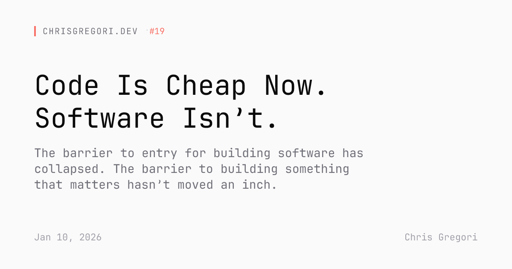
On one hand, we are witnessing the true democratisation of software creation. The barrier to entry has effectively collapsed. For the first time, non-developers aren’t just consumers of software - they are the architects of their own tools.
The democratisation effect is something I’ve been thinking about myself, as hiring developers or learning to code doesn’t come cheap. However, if it allows non-profits to build ideas that can make our world a better place, then that is a good thing.
We’re entering a new era of software development where the goal isn’t always longevity. For years, the industry has been obsessed with building “platforms” and “ecosystems,” but the tide is shifting toward something more ephemeral. We’re moving from SaaS to scratchpads.
A lot of this new software isn’t meant to live forever. In fact, it’s the opposite. People are increasingly building tools to solve a single, specific problem exactly once—and then discarding them. It is software as a disposable utility, designed for the immediate “now” rather than the distant “later.”
I’ve not thought about it in this way but this is a really good point. When you make code cheap, it makes it easier to create bespoke short-lived solutions.
The real cost of software isn’t the initial write; it’s the maintenance, the edge cases, the mounting UX debt, and the complexities of data ownership. These “fast” solutions are brittle.
Though, as much as these tools might democratise software development, they still require engineering expertise to be sustainable.
what a load of bull.
AI doesn’t “democratise” coding. One still needs to understand the basics of computer science, as well as higher level software design, to make use of AI tools and get actually usable results.
LLMs can write good code but they require constant guidance to do so. This is something that people need to understand. AI in coding is like Photoshop to an “analog” artist - super useful IF you know what you’re doing, but as a complete stranger to the topic, all you’ll do is basic tinkering.
The democratisation effect is something I’ve been thinking about myself, as hiring developers or learning to code doesn’t come cheap.
It’s not really “democratizing” anything, since anything made that isn’t like a simple calendar or forum will come with more bugs than working features. Low and no-code development options have been available for ages, so “doesn’t know how to code” was never an actual barrier to making software. Not only that, learning to code could be done effectively for free for well over 15 years now, online resources have only gotten better. It was never about the (lack of) money, it was always about time needed. “I don’t want to/can’t learn this, yet I want the thing done” - that’s why we pay professionals.
However, if it allows non-profits to build ideas that can make our world a better place, then that is a good thing.
At best, they’ll get semi-working prototypes. At worst, they’ll try to sell said prototypes as end products. Besides, anything that is “a disposable utility, designed for the immediate “now” rather than the distant “later.”” is extremely unlikely to make the world a better place.