Dwarf planets should count too. So should most of the moons. Anywhere you could land and walk around should be considered a world. It kind of misrepresents our solar system to think of it as only having 8 or 9 important bodies orbiting the Sun just because some of them are gravitationally entangled with each other.
I think we need a new category that includes dwarf planets and moons, but does not include gas giants and anything too small to have an atmosphere. Basically a “could be terraformed in a sci-fi novel” category.
the thing about an atmosphere is that it protects you from a lot of radiation. like, alpha radiation makes a significant part of the radiation hitting you in outer space, but it’s too weak to go through a sheet of paper so it’s also gonna be stopped by an atmosphere of a planet. and the same goes for beta radiation, which is also easily stopped by an atmosphere. and that’s significant because it protects you from like 99% of all (particle) radiation.
on top of that an atmosphere replenishes volatile chemicals like CO2 and H2O all the time (or at least some volatile molecules) and that’s nice-to-have.
Also important is the heat capacity of the atmosphere. Even if the atmosphere is thin, it makes a lot of difference. I should go about calculating the difference that mars’ atmosphere makes in terms of temperature sometimes. Like, how hot/cold would it be in the day/night if it didn’t have an atmosphere. I guess it would be more extreme, but by how much? I should look into that sometime.


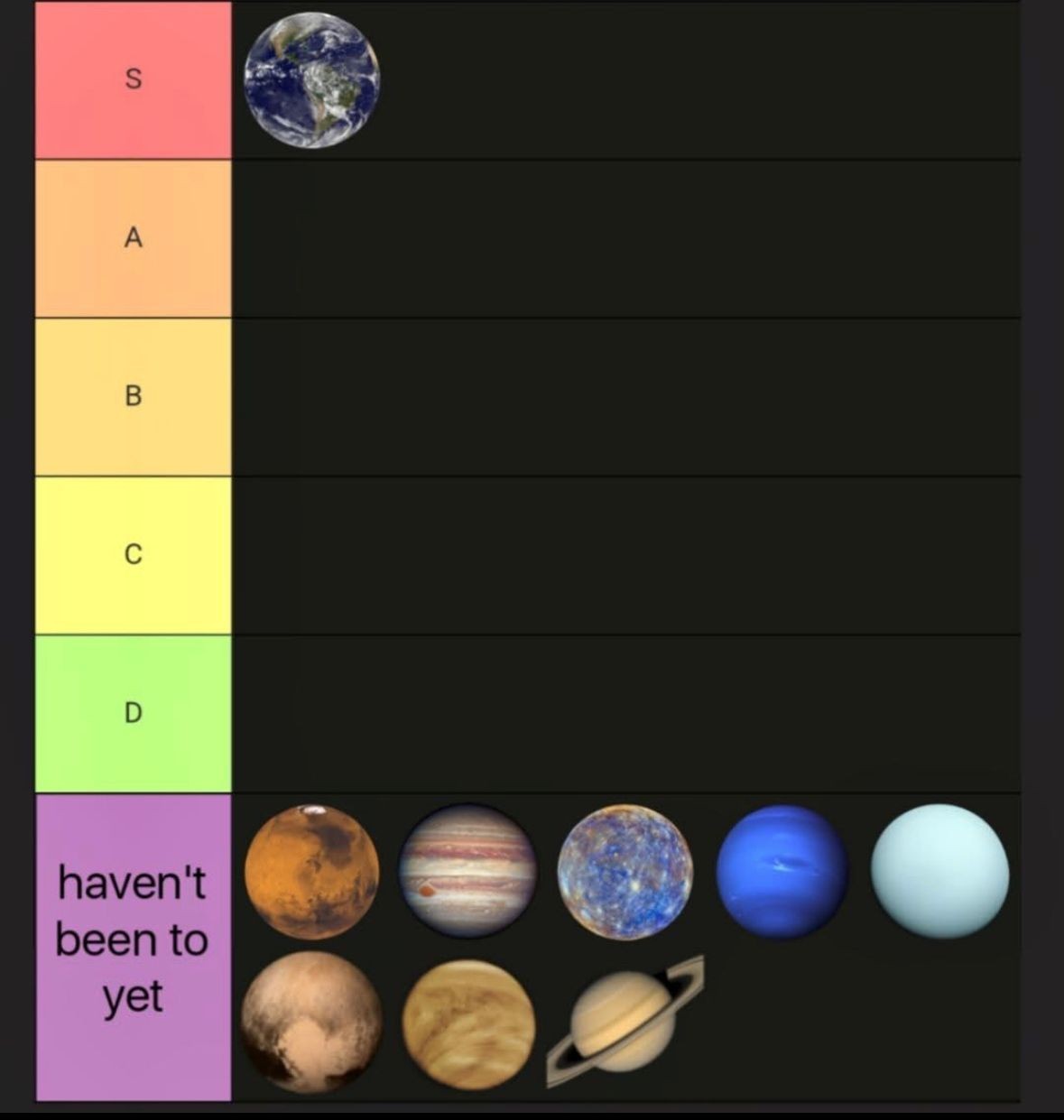
Dwarf planets should count too. So should most of the moons. Anywhere you could land and walk around should be considered a world. It kind of misrepresents our solar system to think of it as only having 8 or 9 important bodies orbiting the Sun just because some of them are gravitationally entangled with each other.
I think we need a new category that includes dwarf planets and moons, but does not include gas giants and anything too small to have an atmosphere. Basically a “could be terraformed in a sci-fi novel” category.
That would disqualify the gas giants. I think the criteria needs workshopping…
I meant it to be taken as sufficient but not required
the thing about an atmosphere is that it protects you from a lot of radiation. like, alpha radiation makes a significant part of the radiation hitting you in outer space, but it’s too weak to go through a sheet of paper so it’s also gonna be stopped by an atmosphere of a planet. and the same goes for beta radiation, which is also easily stopped by an atmosphere. and that’s significant because it protects you from like 99% of all (particle) radiation.
on top of that an atmosphere replenishes volatile chemicals like CO2 and H2O all the time (or at least some volatile molecules) and that’s nice-to-have.
Also important is the heat capacity of the atmosphere. Even if the atmosphere is thin, it makes a lot of difference. I should go about calculating the difference that mars’ atmosphere makes in terms of temperature sometimes. Like, how hot/cold would it be in the day/night if it didn’t have an atmosphere. I guess it would be more extreme, but by how much? I should look into that sometime.