Red Onions (and every other not-red food that’s called red) is older in the English language than the word “purple”.
Purple is a relatively modern concept in English having first been used circa 900AD. Before that basically everything towards the magenta part of the spectrum was all just called red.
See also Orange, the colour is named after the fruit and not the other way round.
Cultures around the world divide the color spectrum up in wildly different ways, which really highlights the absurdity of “color” being a real, objective property. There’s one culture (I forget which, somewhere in Africa) where all the “dark” variants of colors are called by the same name. Other cultures often combine texture and other properties into their words for colors.
The concept of purple is older than English, though. I guess when English chose to adopt it is the main question, but should be clarified that the term where “purple” derives from goes back to the ancient Romans, who recognized it as a distinct color used for royalty given the difficulty in obtaining it.
It does have me wondering exactly when red onions first arrived in the UK, or what the Romans may have called it (potentially before those dirty Britons got their hands on it).
I also know that, when boiled, they yield a very rich, red color. Could maybe be named “red” due to that? Some Orthodox Christians/eastern Europeans traditionally use red onions to dye eggs for Easter.
I was always curious about this! I’m bilingual and I always get mixed up because they’re actually called “purple onions” in Spanish. I always forget which language calls it which, but knowing this is definitely helpful!
The Latin and Greek speaking parts of the world probably had a word for purple by that point. Remember the Angles, Saxons, and Jutes who would evolve into the medieval Anglo-Saxons were from around modern continental Denmark to about the modern Hanover region. This area didn’t really have the color purple all that much and frankly speaking Britain ain’t much better on that front, probably why it took till around the viking age to get a word for it since that’s when pan European trade started to pick up again to a large enough degree for purple dyes to start getting to Britain on a regular basis.


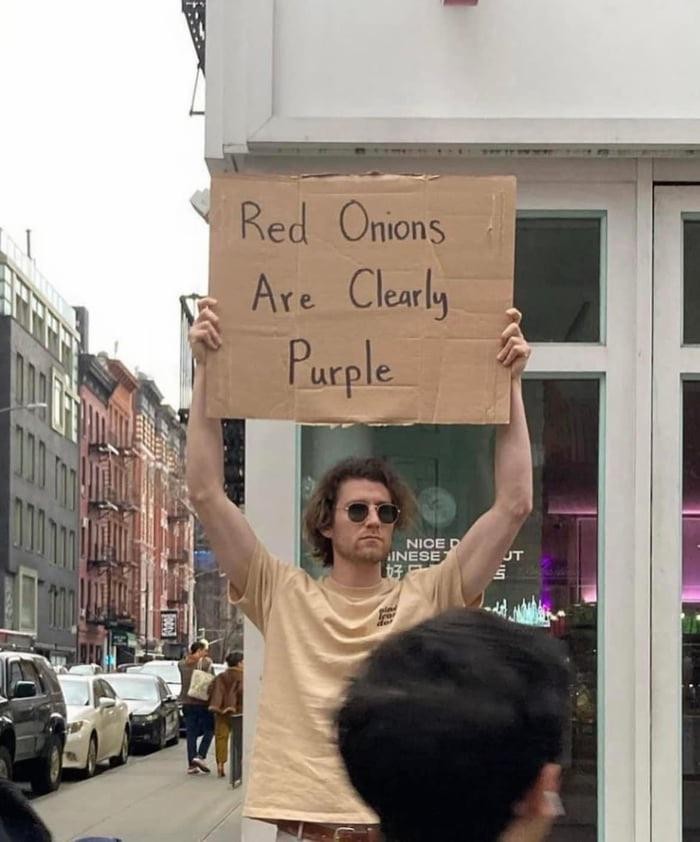
Red Onions (and every other not-red food that’s called red) is older in the English language than the word “purple”.
Purple is a relatively modern concept in English having first been used circa 900AD. Before that basically everything towards the magenta part of the spectrum was all just called red.
See also Orange, the colour is named after the fruit and not the other way round.
See also: ‘robin red breast’ to describe the European robin, which very clearly has an orange breast:
Lil-red-throat in German
-chen und -lein machen alle Dinge klein.
~(It’s called Rotkehlchen. Proverb: Suffixes -chen and -lein make all things small)~
And before that we have people looking at colours entirely differently, like Homer calling the sea the colour of red wine.
Which my Greek teacher would explain by saying “my pencil is the the same shade of yellow as your book is blue”.
Or perhaps Homer was colorblind?
Cultures around the world divide the color spectrum up in wildly different ways, which really highlights the absurdity of “color” being a real, objective property. There’s one culture (I forget which, somewhere in Africa) where all the “dark” variants of colors are called by the same name. Other cultures often combine texture and other properties into their words for colors.
It’s the same reason why ”Violets are blue”.
Roses are red and violets are blue, You have been misled, for that isn’t true
Roses are red, but nobody cares, Waxed lightly weathered, cut copper stairs
The concept of purple is older than English, though. I guess when English chose to adopt it is the main question, but should be clarified that the term where “purple” derives from goes back to the ancient Romans, who recognized it as a distinct color used for royalty given the difficulty in obtaining it.
It does have me wondering exactly when red onions first arrived in the UK, or what the Romans may have called it (potentially before those dirty Britons got their hands on it).
I also know that, when boiled, they yield a very rich, red color. Could maybe be named “red” due to that? Some Orthodox Christians/eastern Europeans traditionally use red onions to dye eggs for Easter.
I was always curious about this! I’m bilingual and I always get mixed up because they’re actually called “purple onions” in Spanish. I always forget which language calls it which, but knowing this is definitely helpful!
In Bangla, we call the color peyaji, which is basically “onion-y”. It’s also what we call onion fritters, and they’re absolutely delicious.
Edit: Just remembered that we also use it as a slang for fucking around. Not sure where that came from lol.
Yum, onion fritters!
Wasn’t purple a “royal” colour back in Roman toga times? Maybe it was called something different?
It was. It was the royal color because it was famously hard and expensive to make purple dyes out of sea snails.
https://en.wikipedia.org/wiki/Tyrian_purple
It was “purpura” in Latin. OP said purple is relatively modern in English.
The Latin and Greek speaking parts of the world probably had a word for purple by that point. Remember the Angles, Saxons, and Jutes who would evolve into the medieval Anglo-Saxons were from around modern continental Denmark to about the modern Hanover region. This area didn’t really have the color purple all that much and frankly speaking Britain ain’t much better on that front, probably why it took till around the viking age to get a word for it since that’s when pan European trade started to pick up again to a large enough degree for purple dyes to start getting to Britain on a regular basis.
Yes but not in English, which was my point
Look, man, I’m not concerned with what middle earth or Mordor or whatever can see, I’m here on the planet U S of A.
Wow, thank you!
Now when people call me color-blind cause I don’t care about color matching or their names, I can just say I’m very old fashioned!