

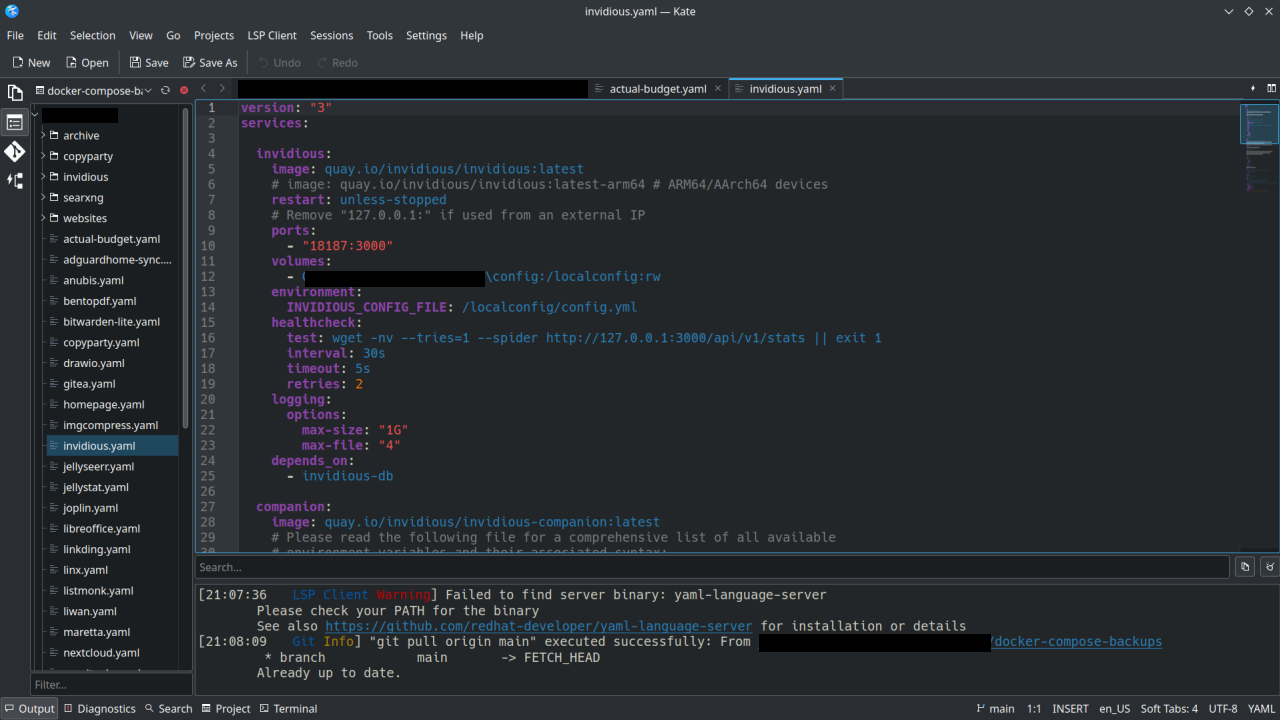
I have been using KDE via Kubuntu for about 2 years now, other distros with Gnome before that. Based upon the name (KDE Advanced Text Editor, K.A.T.E.) I always thought of Kate as an alternative to Notepad++ or something like that. Like a highend note-taking app.
I recently started using Kate for managing my Docker-Compose yaml files on my homelab, using the Git functionality to sync to my repos and doing some web development. It’s basically an alternative to VSCode or Codium.
Thanks to the devs who work on Kate . If you don’t hear it enough we appreciate you!
Curious if anyone knows this, does it use the same buffering system as N++? Meaning, if I open a log file in N++ that is still being written to it never has an issue with blocking the program writing to the file since (it seems) to open it in a separate buffer that can get updated as the file does. A very handy feature for the logs I use, and if Kate can do that I’m all in.
I will test it myself obv, but perhaps someone will be able to answer before I’m able to test, and then also the information will be here :)
I can verify that it appears to work similar to N++ on a Windows install. Another program can ‘own’ the file being open and Kate will be able to have it open and read in new changes. Very cool! New tool for the toolbox
Hmm, if I understand you correctly, this is about Windows blocking access to files while they’re being accessed by other processes. Kate is primarily built for Linux where this would not be a problem to begin with, so it is well-possible that it does not handle this gracefully.
But it does actually keep its own buffer for files. By default, you have to actively click in the UI before it will load the changes from the file. It does watch the file for file changes, but I don’t think, it has to keep the file open for that, since there’s kernel APIs to be notified for file changes on all mainstream operating systems these days.
So, uh, TL;DR: I don’t actually know, but I’m somewhat optimistic. 🫠