

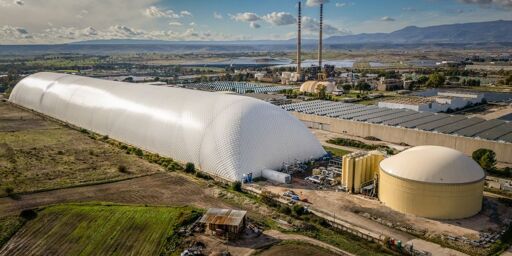
"This giant bubble on the island of Sardinia holds 2,000 tonnes of carbon dioxide. But the gas wasn’t captured from factory emissions, nor was it pulled from the air. It came from a gas supplier… “The facility compresses and expands CO2 daily in its closed system, turning a turbine that generates 200 megawatt-hours of electricity, or 20 MW over 10 hours.”
Sure wish they mentioned the effeciency.
Could be very high, even the waste heat from the compression could be used to achieve more compression and turbines get to above 90%, that all depends on the scales they’re building this at. 70% overall doesn’t seem unrealistic as an educated guess.
On their website (energydome.com) they claim “75%+” round trip efficiency, so not a bad guess!
That’s a hell of a lot better than most other systems. If true, and if scalable, this is a huge innovation.
compressors, turbines (like steam turbines), piping, some of which heat-resistant (500C), container for liquid carbon dioxide, lots of plastic for the bubble, something for thermal storage, dry and clean carbon dioxide, these aren’t unusual or restricted resources, don’t depend on critical raw materials or anything like that
Compressed air without heat recovery is more like 30%, so this is huge
Carbon dioxide can be liquefied relatively easily which is what i guess makes this efficient
I was just about to bang out that they must lose a lot of heat from the compression. But apparently not! That’s amazing.
I’m struggling to think of systems that would significantly outperform “75%+”. Chilled superconducting coils? Those are expensive, and would fail rather catastrophically.
No. Waste heat (which is always low-temperature in respect to the device in question) can by definition not be converted to mechanical work. (Edit: to uninformed people downvoting this, this is nothing else than Carnot’s law in action.)
Otherwise, one could build a perpetuum mobile: Convert heat to mechanical work, use that work to generate heat, convert it to work again, and so on. You’d have a machine that generates energy out of nothing, and that’s not possible because of the law of energy conservation.
https://en.wikipedia.org/wiki/Recuperator
Without it you should dismiss the whole article as worthless garbage
Damned good question, and I played stump-the-search-engine for 15 minutes and it’s like they’re AVOIDING that question
deleted by creator