The x86css didn’t work because CSS @function rules aren’t yet implemented on Firefox (by extension, Waterfox). I’m not gonna spin up the Chromium.
Then I tried other projects from this lyra.horse website, I tried the CSS clicker (a clicker game which uses no JS, just CSS and HTML). It’s very interesting. There are a few glitches (e.g. the “Name your website:” should behave like input[type='text'] but actually behaves like textarea, thus allowing newlines where the semantic (a title) expects none; IIRC, there are CSS properties allowing a [contenteditable] element to restrict the input to an one-line text) but interesting nonetheless.
The only problem, besides the limited support for certain state-of-the-art features across browser engines, is the fact that this “CSS-oriented functional programming” ends up requiring more processing power than JS does, because JS has optimizations that CSS often lack.
Don’t get me wrong: it’s really interesting, and I’m quite fond of unorthodox approaches to programming. I myself once used nodemon (a live-reloading CLI tool intended for Node.js but also usable for other programming languages) to compile and run an Assembly (GNU Assembly) Linux program as the code was being edited, and I also used the same Assembly tool-chain to code a “program” whose compilation result wasn’t an actual runnable program, but a whole, valid BMP (Bitmap) image structure, full with a linear gradient, I achieved this by using compiler macros. This is how much I’m fond of unorthodox programming, so I’m far from being against CSS programming, much to the contrary: it’s awesome!..
… but this whole approach, using CSS as a whole functional programming language, unfortunately ends up heating my old poor I5-7200U laptop…

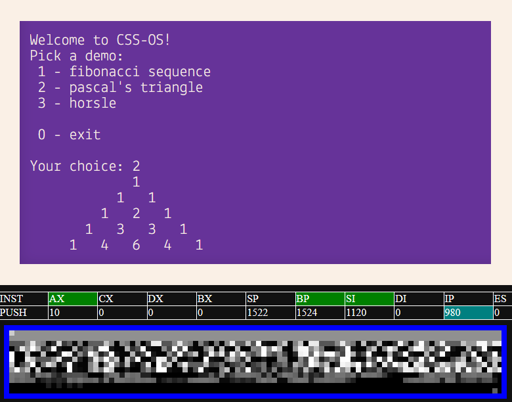
@[email protected] @[email protected]
The x86css didn’t work because CSS
@functionrules aren’t yet implemented on Firefox (by extension, Waterfox). I’m not gonna spin up the Chromium.Then I tried other projects from this lyra.horse website, I tried the CSS clicker (a clicker game which uses no JS, just CSS and HTML). It’s very interesting. There are a few glitches (e.g. the “Name your website:” should behave like
input[type='text']but actually behaves liketextarea, thus allowing newlines where the semantic (a title) expects none; IIRC, there are CSS properties allowing a[contenteditable]element to restrict the input to an one-line text) but interesting nonetheless.The only problem, besides the limited support for certain state-of-the-art features across browser engines, is the fact that this “CSS-oriented functional programming” ends up requiring more processing power than JS does, because JS has optimizations that CSS often lack.
Don’t get me wrong: it’s really interesting, and I’m quite fond of unorthodox approaches to programming. I myself once used
nodemon(a live-reloading CLI tool intended for Node.js but also usable for other programming languages) to compile and run an Assembly (GNU Assembly) Linux program as the code was being edited, and I also used the same Assembly tool-chain to code a “program” whose compilation result wasn’t an actual runnable program, but a whole, valid BMP (Bitmap) image structure, full with a linear gradient, I achieved this by using compiler macros. This is how much I’m fond of unorthodox programming, so I’m far from being against CSS programming, much to the contrary: it’s awesome!..… but this whole approach, using CSS as a whole functional programming language, unfortunately ends up heating my old poor I5-7200U laptop…