It’s more difficult from first-language English because the languages are so different, but Japanese is fundamentally a very simple language. There’s no complicated articles, plurals, prepositions, etc. There’s not 100 different verb conjugations (like Spanish for example), there’s only a few basic ones that can be used indiscriminately for first-, second-, and third-person. You don’t really need to use pronouns and most syntax can be omitted if it doesn’t add necessary context.
The biggest thing making Japanese an “easy” language to learn is the huge amount of learning material available. It’s probably second only to English (and maybe Spanish) in the amount of popular TV, movie, and music that can be used for practice.
Even kanji is not really difficult once you get into it; only time-consuming.
Yup, kanjis made me drop my attempt of learning Japanese a few years ago. I got through the two sets of kanas okay (though シ and ツ being completely different characters is bullshit), but then I got to kanjis, and realised how illogical many of them are, like they often have multiple meanings and pronunciations depending on context, or the same sound syllable often can be written as multiple kanjis depending on the meaning, and I noped the fuck out.
Coming from Hungarian, English is already pretty bad in that you can’t always tell how a word is pronounced from how it’s written down*, Japanese is like that up to 11.
* E.g. even after years of fluency I sometimes can’t remember if the “ch” in “chore” and “chasm” are pronounced like in “chord” or “choice”.
Your asterisk example is correct.
For those less fluent: The “ch” in “chore” is the same as in “choice” and the “ch” in “chasm” is the same as “chord”.
Which is yet another example that english is really just three languages in a trench coat that mugs other languages in dark alleys for spare syntax.


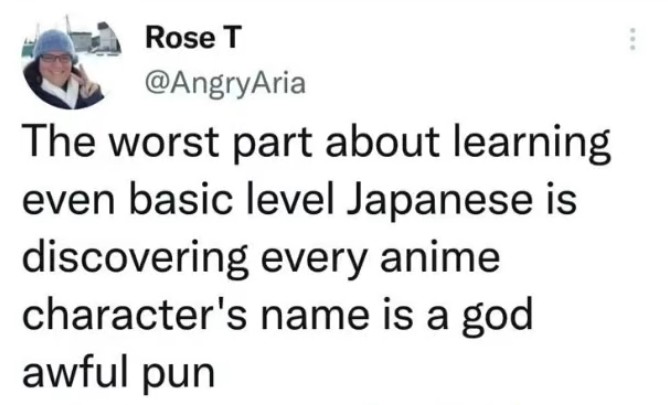
I imagine it’s easy, with English as a starting point, up until you get into the larger set of pictograms.
It’s more difficult from first-language English because the languages are so different, but Japanese is fundamentally a very simple language. There’s no complicated articles, plurals, prepositions, etc. There’s not 100 different verb conjugations (like Spanish for example), there’s only a few basic ones that can be used indiscriminately for first-, second-, and third-person. You don’t really need to use pronouns and most syntax can be omitted if it doesn’t add necessary context.
The biggest thing making Japanese an “easy” language to learn is the huge amount of learning material available. It’s probably second only to English (and maybe Spanish) in the amount of popular TV, movie, and music that can be used for practice.
Even kanji is not really difficult once you get into it; only time-consuming.
The syntax is fine, but learning kanji can be grueling
Yup, kanjis made me drop my attempt of learning Japanese a few years ago. I got through the two sets of kanas okay (though シ and ツ being completely different characters is bullshit), but then I got to kanjis, and realised how illogical many of them are, like they often have multiple meanings and pronunciations depending on context, or the same sound syllable often can be written as multiple kanjis depending on the meaning, and I noped the fuck out.
Coming from Hungarian, English is already pretty bad in that you can’t always tell how a word is pronounced from how it’s written down*, Japanese is like that up to 11.
* E.g. even after years of fluency I sometimes can’t remember if the “ch” in “chore” and “chasm” are pronounced like in “chord” or “choice”.
(edit: spelling)
Your asterisk example is correct. For those less fluent: The “ch” in “chore” is the same as in “choice” and the “ch” in “chasm” is the same as “chord”.
Which is yet another example that english is really just three languages in a trench coat that mugs other languages in dark alleys for spare syntax.